
What is Geoscience?
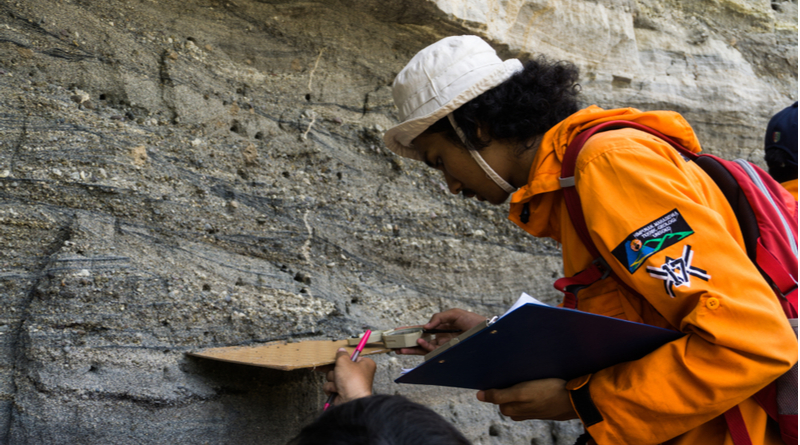
Geoscience, or Earth Science, is the study of the Earth and the processes that form and shape the Earth’s surface, the natural resources on the Earth and how water and ecosystems are interconnected.
Geoscience uses tools and techniques from other science fields such as chemistry, physics, biology, and mathematics to study the physical aspects of the Earth, such as its composition, structure, and processes, to learn about its past, present, and future.
Geoscientists work with minerals, soils, energy resources, fossils, oceans and freshwater, the atmosphere, weather, environmental chemistry and biology, natural hazards and even study rocks on our moon and other planets in our solar system.
What 3rd level courses are available?
Universities and colleges in Ireland are offering Geosciences courses in the following subject areas:
- Science Project Course: Geosciences – Learn to Investigate and produce an in-depth project about geohazards within a range of defined topics: atmospheric and hydrologic hazards; earthquakes; landslides; meteorite impacts; volcanoes; and tsunami.
- Geology – Introduces the fundamentals of the scientific study of the Earth and the practical skills required to understand and interpret geological features and processes.
- Ancient Mountains: Practical Geology in Scotland – Study igneous, metamorphic and structurally complex rocks in their natural settings on field trips at this six-day geology residential school in the Scottish Highlands.
- Earth and Ocean Sciences – A broad introduction to the study of the Earth’s solid geology and its coastal ocean, with hands-on, practical experience of the techniques employed within the fields of geology, oceanography, and Earth observation.
- Oceanography – A study of the oceans physics, chemistry and biology, and the structure of the basins that contain them.
- Life in The Oceans: Exploring Our Blue Planet – A fascinating voyage into the oceans; explore the seas and marine environments
- CK 404 Environmental and Earth System Sciences – The study of the various components of our earth systems is crucial to our management and protection of essential resources.
- Biological, Earth and Environmental Sciences – The study of the Earth, biological and environmental sciences.
- Volcanoes, Earthquakes and Tsunamis – Discover how and why earthquakes, tsunamis and volcanic eruptions occur and what outcomes they have.
- Our Dynamic Planet: Earth and Life – This course explores the structure of the Earth from its core to the atmosphere, and investigates how the Earth system works from a geological perspective.
- Earth in Crisis: Environmental Policy in an International Context – Investigate causes and consequences of international environmental problems and resource conflicts, including loss of biological diversity, water allocation, urbanisation and climate change.
Studying Geosciences in college
There are many Geosciences courses that take place over 1 year to 4 years depending on the course and modules selected. There are also part-time courses and night courses available so you can be sure to fit in your studies no matter what your schedule is like.
Courses will cover theory work through lectures, assignments, tutorials and taught modules. Assessments will take place on a continuous basis with written examinations and practical assignments combined in order to achieve a qualification. A course in one of the geosciences sets you up for a career within the energy, environmental or engineering sectors and related work experience can help to give you the edge when job hunting
You could consider work experience or fieldwork experience which can be helpful in potentially securing a job while also having an opportunity to determine what type of a career you want. This can be done through a course that offers a year out in the industry or by finding your own placements.
Environment agencies or local authorities may offer related work experience or volunteer opportunities. You could also contact energy companies to find out about available summer placements or internships.
Work Experience will not only give you the opportunity to obtain a deeper knowledge and understanding of the industry, it will also give you a chance to do some essential networking with other industry professionals and gain valuable contacts for the future.
Career options
After completing a course in Geosciences you will be able to get started in a career that uses specific knowledge of the Earth and its resources.
Working hours will depend on whether you are employed by a company with set business hours or if you are contracted to various facilities or companies. The hours are usually full time, Monday to Friday. Other work within the field could require unsocial, irregular or long hours. For example, geoscientists involved in exploration can expect time abroad or at sea followed by a similar length of time on leave, and then the same length of time-based in the office.
Self-employment and freelance work are possible. With experience, you may be able to establish your own consultancy in a particular field such as base metal exploration or sedimentology.
Positions are available worldwide in oil and mineral exploration so working as a geoscientist can involve lots of travel abroad or at sea depending on your area of specialism.
Typical employers in the Geosciences field include international oil companies, specialist geophysical companies, petroleum exploration companies, mining companies, contractors, consultants, the water industry and software companies.
Related jobs include:
- Geologist
- Engineering geologist
- Environmental consultant
- Geochemist
- Geophysicist
- Geoscientist
- Geotechnical engineer
- Palaeontologist
- Seismologist
- Meteorologist
- Volcanologist
- Hydrologist
- Hydrographic surveyor
- Hydrogeologist
- Oceanographer
- Mudlogger
- Wellsite geologist
- Drilling engineer
- Energy engineer
- Environmental engineer
- Minerals surveyor
- Quarry manager
- Sustainability consultant
Further study
After completing a course in Geosciences you may choose to pursue further study in a specialist field to increase your knowledge base and skillset. Postgraduate study can also be used as a means to change career focus or to gain professional qualifications required to practise in certain career areas such as earth sciences, hydrogeology, nuclear decommissioning, petroleum engineering, petroleum geophysics and waste management.
FAQ
What are the Geosciences?
Geosciences are very relevant and broad disciplines covering topics from geography, geology, meteorology, environmental studies, chemistry, physics, astronomy, petroleum geology, mineralogy and hydrogeology. Within the field, there are many specialisations for further research and for career opportunities as well such as engineering geologists, geomorphologists, geophysicists, mineralogists, geochemists, glacial geologists, structural geologists, petroleum geologists, petrologists, sedimentologists, hydrogeologists and more. A career in geosciences offers broad scope to anyone interested in the Earth and how it works.
Why are Geosciences important?
Geoscientists help protect the planet by studying it, learning from it, and predicting what the future will bring. They perform environmental assessments and study global environmental systems, help to locate water, mineral, and energy resources and they can help to predict geological disasters.
The Geosciences community provides the knowledge, experience, and ingenuity to meet society’s demands for natural resources, environmental quality, and resilience to hazards.
Where can I study Geosciences?
Explore your options here
Did You Know?
- The length of Earth’s day is increasing. When Earth was formed 4.6 billion years ago, its day would have been roughly six hours long. By 620 million years ago, this had increased to 21.9 hours. Today, the average day is 24 hours long but is increasing by about 1.7 milliseconds every century.
- Ironically, the driest place in the world — the Atacama Desert in northern Chile — is next to the biggest body of water — the Pacific Ocean. Average annual rainfall in Arica, Chile, is just 0.8 millimetres (0.03 inches).
- All stars, like our sun, age and eventually die. As the sun exhausts its supply of hydrogen, it will collapse under gravity, ultimately ballooning into a red giant that is 100 times bigger and 2,000 times more luminous, vaporizing Earth in the process. But don’t worry; it won’t happen for about five billion years.
- If you could separate the Earth out into piles of material, you’d get 32.1 % iron, 30.1% oxygen, 15.1% silicon, and 13.9% magnesium. Of course, most of this iron is actually located at the core of the Earth. If you could actually get down and sample the core, it would be 88% iron. And if you sampled the Earth’s crust, you’d find that 47% of it is oxygen.
- Earth’s atmosphere is thickest within the first 50 km from the surface or so, but it actually reaches out to about 10,000 km into space. It is made up of five main layers – the Troposphere, the Stratosphere, the Mesosphere, the Thermosphere, and the Exosphere. As a rule, air pressure and density decrease the higher one goes into the atmosphere and the farther one is from the surface.












Comments